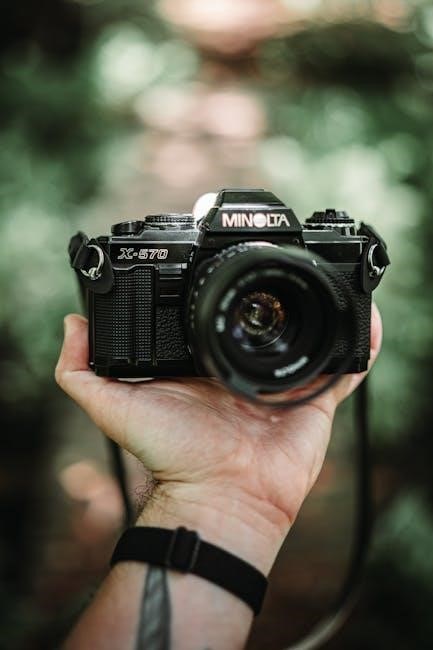
The Minolta SRT 101 boasts readily available instruction and service manuals, often found as free PDF downloads online via resources like the Internet Archive.
Numerous sites offer these manuals, addressing potential PDF viewing issues and providing guidance on mercury battery replacements for optimal camera function.
These resources cater to both English and international users, ensuring accessibility for enthusiasts seeking to understand and maintain this classic camera;
Overview of the SRT 101
The Minolta SRT 101, a popular 35mm SLR, is well-supported by extensive documentation, including detailed instruction manuals readily available in PDF format. These manuals, often sourced from archives like the Internet Archive, cover all aspects of operation.
They detail the camera’s controls, film loading procedures, exposure settings, and focusing techniques. Resources also address the original mercury battery issue, offering alternative battery suggestions and installation guidance.
The availability of these manuals ensures users can fully utilize and maintain this iconic camera, even decades after its production.
Historical Context and Significance
The Minolta SRT 101, released in 1969, gained prominence as an accessible and reliable SLR, with its enduring legacy supported by widely available instruction manuals. These manuals, now often found as free PDF downloads, reflect the camera’s importance to a generation of photographers.
Their continued accessibility demonstrates the lasting interest in this model. The detailed documentation helped users master its features, contributing to its widespread adoption and influence on subsequent camera designs.
The preservation of these manuals is vital for understanding the SRT 101’s place in photographic history.
Camera Components and Controls
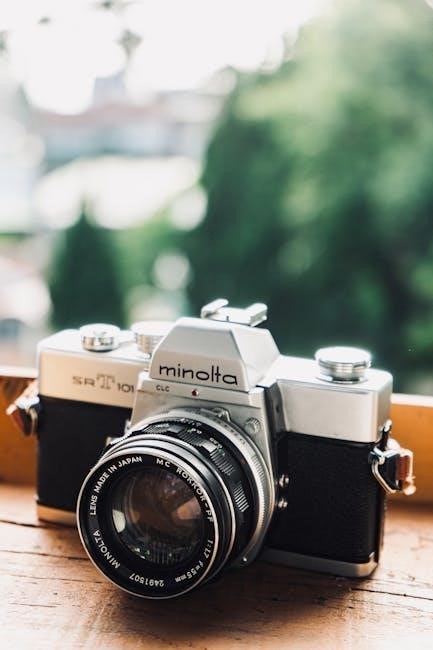
Manuals detail the SRT 101’s body, shutter speed dial, aperture ring, focusing screen, and film advance—essential components for understanding operation and maintenance.
Body and Build Quality
The SRT 101’s instruction manuals don’t extensively detail material composition, but users consistently praise its robust, all-metal construction. This contributes to a substantial feel and perceived durability.
The camera’s solid build suggests a focus on longevity, a common characteristic of cameras from this era. While manuals focus on operational aspects, the physical quality is implicitly highlighted through maintenance recommendations.
Careful cleaning instructions, found within the manuals, emphasize preserving the camera’s exterior condition, further indicating its intended lasting value.
Shutter Speed Dial
Minolta SRT 101 instruction manuals dedicate significant attention to the shutter speed dial, illustrating its range from 1 second to 1/1000th of a second, plus Bulb mode.
Manuals emphasize the importance of selecting the correct speed in conjunction with aperture for proper exposure. Diagrams clearly show the dial’s location and operation.
Troubleshooting sections address potential issues like a stuck dial, advising against forceful manipulation and suggesting professional servicing if problems persist, as detailed in service manuals.
Aperture Control Ring
Minolta SRT 101 manuals thoroughly explain the aperture control ring’s function on each lens, detailing its f-stop scale – typically ranging from f/2.8 to f/16 or smaller.
Illustrations demonstrate how adjusting the ring alters the lens opening, impacting both exposure and depth of field.
Manuals stress the interplay between aperture and shutter speed for achieving desired photographic effects, and offer guidance on understanding the f-stop values for creative control.
Focusing Screen and Viewfinder
Minolta SRT 101 manuals dedicate sections to understanding the camera’s focusing screen and viewfinder system. They explain the split-image rangefinder at the center, crucial for achieving sharp focus.
Diagrams illustrate how to align images in the split-image to confirm accurate focus.
Manuals also detail the surrounding matte field, aiding composition, and explain how to interpret the viewfinder’s brightness for exposure estimation, enhancing the shooting experience.
Film Advance Lever and Rewind Crank
Minolta SRT 101 manuals provide detailed instructions on operating the film advance lever and rewind crank. They explain the smooth, two-stroke action of the lever for advancing film, emphasizing a consistent rhythm.
Illustrations demonstrate proper technique for avoiding film jams or damage.
The manuals also cover the rewind crank’s function, detailing how to smoothly retract the film back into the cassette after exposure, ensuring successful film retrieval.

Loading and Unloading Film
Minolta SRT 101 manuals detail film loading, specifying compatible film types and providing step-by-step procedures for insertion and rewinding.
They clearly illustrate the process, ensuring correct film placement and preventing potential damage during loading or unloading.
Film Type Compatibility
Minolta SRT 101 manuals confirm compatibility with standard 35mm film formats, including black and white, color negative, and color slide (transparency) films.
The camera accommodates various ISO/ASA speeds, allowing photographers flexibility in different lighting conditions. While modern films are readily usable, the manuals also address considerations for older film types.
Users should consult the manual for guidance on selecting appropriate film based on their photographic goals and desired image characteristics, ensuring optimal results with this versatile camera.
Film Loading Procedure
Minolta SRT 101 manuals detail a straightforward film loading process. First, open the camera back using the release latch. Next, insert the film canister into the left side and thread the film leader onto the take-up spool on the right.
Advance the film using the film advance lever, ensuring the sprocket holes engage properly. The manual emphasizes careful handling to avoid damaging the film or camera mechanism.
Finally, close the camera back and continue advancing the film until the frame counter reaches ‘1’, ready for the first exposure.
Film Rewinding Procedure
Minolta SRT 101 manuals illustrate a simple film rewinding process. Press the film rewind button on the camera base. Then, lift the rewind crank and gently turn it in the direction of the arrow, as detailed in the PDF guides.
Maintain a moderate, even speed to avoid film breakage. The film will gradually retract back into the canister.
Once fully rewound, open the camera back and remove the film canister, completing the process as outlined in available online resources.

Exposure Settings and Metering
Minolta SRT 101 manuals explain aperture and shutter speed control, alongside built-in light meter operation for accurate exposure, as found in PDF guides.
Understanding Aperture and Shutter Speed
Minolta SRT 101 instruction manuals thoroughly detail the interplay between aperture and shutter speed, crucial for controlling light and achieving desired photographic effects. Aperture, measured in f-stops, governs lens opening size, impacting depth of field – a wider aperture (smaller f-number) creates shallow focus, while a narrower aperture (larger f-number) yields greater depth.
Shutter speed, conversely, dictates how long the film is exposed to light, influencing motion blur. Faster shutter speeds freeze action, while slower speeds allow for motion blur. Manuals emphasize mastering these settings for proper exposure, often referencing the camera’s built-in meter as a guide.
Built-in Light Meter Operation
Minolta SRT 101 manuals explain the camera’s center-weighted light meter, activated by a lever near the shutter speed dial. The viewfinder displays a needle indicating exposure; aligning it with the center mark signifies correct exposure. Manuals caution that meter accuracy depends on proper battery function, noting the original mercury batteries are obsolete.
Users are directed to alternative battery options and installation instructions. Understanding the meter’s limitations, particularly in challenging lighting, is emphasized, encouraging users to utilize exposure compensation when necessary for optimal results.
Metering Modes and Considerations
Minolta SRT 101 manuals detail the camera’s center-weighted metering system, prioritizing light measurement from the central area of the frame. This mode is suitable for general scenes, but manuals advise caution with high-contrast situations.
Users are encouraged to consider the scene’s dynamic range and utilize spot metering techniques – mentally assessing brightness – for accurate exposure. The manuals emphasize that the meter responds to reflected light, potentially leading to inaccuracies with strongly backlit or reflective subjects.
Exposure Compensation
Minolta SRT 101 manuals don’t explicitly detail a dedicated exposure compensation dial; adjustments are achieved through aperture and shutter speed control. Users must understand how these settings interact to override the meter’s reading when necessary.
For brighter scenes, decreasing exposure (smaller aperture or faster shutter) is advised, while darker scenes require increasing it. The manuals stress the importance of understanding the light meter’s limitations and making informed decisions based on scene analysis.
Focusing Techniques
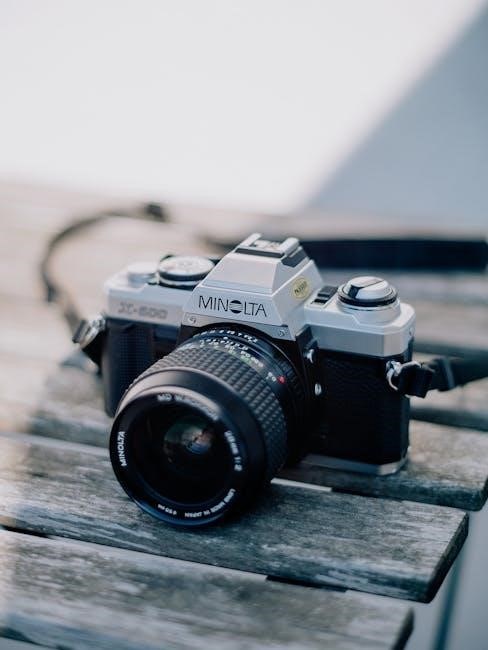
Minolta SRT 101 manuals emphasize utilizing the split-image rangefinder for precise focusing, alongside understanding depth of field for desired sharpness.
Focus lock and pre-focusing techniques are also explained for capturing moving subjects effectively.
Using the Split-Image Rangefinder
The Minolta SRT 101’s instruction manual details how to achieve sharp focus using its innovative split-image rangefinder. This system presents a central image divided into two sections; when perfectly aligned, the subject is in focus.
Rotate the focusing ring until the split image merges into a single, cohesive image. This indicates optimal sharpness. Manuals often highlight practicing this technique for quick and accurate focusing, especially in challenging lighting conditions. Mastering this feature is key to utilizing the camera’s full potential.
Depth of Field Control
The Minolta SRT 101’s manual explains depth of field, the area appearing acceptably sharp in an image. It’s controlled by aperture settings – smaller apertures (higher f-numbers) yield greater depth of field, ideal for landscapes;
Larger apertures (lower f-numbers) create shallow depth of field, useful for isolating subjects. Manuals demonstrate how to use the lens’s aperture ring and viewfinder depth-of-field indicators to visualize and achieve desired results, enhancing creative control.
Focus Lock and Pre-Focusing
The Minolta SRT 101’s manual details focus lock, a technique for maintaining focus on a moving subject. Once focused, the shutter button can be partially depressed to lock focus, recomposing the shot while keeping the subject sharp.
Pre-focusing involves setting focus on a point where action will occur. Manuals illustrate anticipating subject movement and triggering the shutter at the decisive moment, ensuring a crisp image despite dynamic scenes.
Using Lenses with the SRT 101
The SRT 101 utilizes the SR mount, offering compatibility with a wide range of Minolta lenses; adapters allow using lenses from other systems.
Manuals emphasize proper lens care and maintenance for optimal performance and longevity of your photographic equipment.
SR Mount Lens Compatibility
The Minolta SRT 101 proudly features the SR mount, a bayonet mount system renowned for its robust construction and widespread adoption by Minolta during its film camera era.
This mount ensures compatibility with a vast selection of Minolta SR-mount lenses, including those from the SR-T series and later iterations like the XG and XD series, though some electronic features may not function.
Instruction manuals often detail the nuances of using various lens types, and highlight the potential for adapting lenses from other manufacturers using readily available adapters, expanding creative possibilities.
Understanding the SR mount’s specifications, as outlined in available documentation, is crucial for maximizing lens performance and ensuring a secure connection.
Adapting Lenses
The Minolta SRT 101, while designed for SR-mount lenses, offers adaptability through readily available adapters, opening doors to a wider range of photographic possibilities.
Instruction manuals don’t directly cover adapter use, but online resources detail adapting lenses from brands like M42, allowing access to a diverse selection of optics.
However, be aware that adapting lenses may introduce limitations, such as the loss of automatic diaphragm control, requiring manual aperture adjustment.
Careful research and adapter selection are vital to ensure compatibility and maintain optimal image quality with the SRT 101.
Lens Care and Maintenance
Minolta SRT 101 lenses, like all optics, require diligent care to maintain performance and longevity. Instruction manuals emphasize protecting the lens elements from dust, scratches, and excessive moisture.
Regularly use a blower to remove loose particles, followed by a soft lens brush for stubborn dust. Avoid harsh cleaning solutions; opt for lens cleaning fluid and microfiber cloths.
Store lenses in a dry, protected environment, utilizing lens caps and cases when not in use to prevent damage and ensure optimal image quality.

Flash Photography
Minolta SRT 101 manuals detail hot shoe use and flash synchronization, outlining compatible flash units for balanced exposure and creative lighting options.
Proper flash exposure control is explained, ensuring well-lit photographs in various shooting scenarios.
Hot Shoe and Flash Synchronization
The Minolta SRT 101 features a standard hot shoe, enabling direct synchronization with compatible electronic flash units. Manuals emphasize correct flash unit attachment and explain the importance of the sync speed setting – typically 1/60th of a second – to avoid dark bands appearing in images.
Proper synchronization ensures the flash fires precisely when the shutter is fully open, illuminating the scene evenly. The manual details how to check for correct flash firing and troubleshoot potential synchronization issues, guaranteeing optimal results when using supplemental lighting.
Flash Exposure Control
The Minolta SRT 101’s manual details flash exposure control, primarily relying on the photographer’s judgment and the flash unit’s guide number. Users must calculate appropriate aperture settings based on the flash-to-subject distance and the flash’s output power.
While the camera lacks dedicated flash automation, understanding the relationship between aperture, distance, and guide number is crucial for achieving correctly exposed images. Manuals often include example calculations and charts to assist photographers in mastering this technique.
Compatible Flash Units
The Minolta SRT 101 utilizes a standard hot shoe, allowing compatibility with a wide range of flash units. Manuals don’t specify exclusive compatibility, meaning many vintage and modern flashes can be used with an adapter if necessary.
However, the camera lacks TTL (Through-The-Lens) flash metering, so flash exposure is primarily controlled manually. Users should consult their flash unit’s manual for proper settings and synchronization information to achieve optimal results with the SRT 101.

Troubleshooting Common Issues
Manuals address shutter, metering, and film advance problems. Online forums and repair services offer solutions for these common Minolta SRT 101 malfunctions.
Shutter Problems
The SRT 101’s service manual is crucial when facing shutter issues. Common problems include slow speeds or a completely unresponsive shutter curtain. Manuals detail cleaning and lubrication procedures, often addressing dried lubricants as a primary cause.
Users should consult the manual for proper disassembly and reassembly instructions, as incorrect handling can worsen the problem. Online resources and forums frequently discuss specific shutter fixes, offering step-by-step guidance and potential solutions for DIY repairs. Remember to exercise caution!
Metering Errors
The Minolta SRT 101’s manual addresses potential metering inaccuracies, often linked to the original mercury battery. Replacing it with a compatible alternative, as detailed in the manual and online guides, is the first troubleshooting step.
If errors persist, the manual suggests checking the meter’s calibration. Online forums discuss potential issues with the CdS cell and offer repair advice. Always consult the manual before attempting any internal adjustments to avoid further complications.
Film Advance Issues
The Minolta SRT 101’s manual details proper film loading and advancing techniques. If the lever feels stiff, the manual advises checking for film obstructions or improper loading. Online resources suggest lubricating the mechanism, but caution against over-lubrication.
If the film isn’t advancing smoothly, the manual recommends inspecting the rewind knob and ensuring it’s correctly engaged. Repair services, linked in online guides, can address more complex mechanical failures.

Maintenance and Care
The SRT 101 manual guides users on cleaning the body and lenses, emphasizing gentle methods. Proper storage recommendations ensure longevity and optimal performance.
Cleaning the Camera Body
The Minolta SRT 101 manual stresses careful cleaning to preserve its functionality and appearance. Use a soft, dry cloth to gently wipe down the exterior, removing dust and fingerprints.
Avoid harsh chemicals or abrasive cleaners, as these can damage the finish. For stubborn grime, lightly dampen the cloth with water, ensuring it’s not overly wet.
Pay attention to the film compartment and viewfinder window, carefully removing any debris. Regular, gentle cleaning will maintain the camera’s condition for years to come.
Lens Cleaning
The Minolta SRT 101 manual emphasizes the importance of meticulous lens care for optimal image quality. Begin by using a blower brush to remove loose dust and particles.
Follow this with a soft lens brush, gently sweeping across the glass surface. For fingerprints or smudges, apply a small amount of lens cleaning solution to a microfiber cloth.
Wipe in a circular motion, avoiding excessive pressure. Inspect the lens for any remaining residue and repeat if necessary, ensuring a clear and sharp viewing experience.
Storage Recommendations
The Minolta SRT 101 manual doesn’t explicitly detail storage, but best practices apply. Store the camera in a cool, dry place, away from direct sunlight and extreme temperatures.
A camera bag or case offers protection from dust and accidental impacts. Remove batteries to prevent corrosion and potential damage.
Consider using silica gel packets to absorb moisture, especially in humid environments. Proper storage ensures the longevity and continued functionality of your SRT 101.
Battery Information
The SRT 101 originally used mercury batteries, now unavailable; manuals suggest alternatives like 1.5V silver oxide or alkaline batteries for continued operation.
Original Mercury Battery Replacement
The Minolta SRT 101 initially utilized a mercury battery, specifically a PX-28 or similar, to power its light meter. However, due to environmental concerns, these batteries are no longer manufactured or legally sold in many regions.
Consequently, users must seek suitable replacements. Instruction manuals and online resources strongly advise against directly substituting with standard alkaline or silver oxide batteries without considering voltage differences.
Using incorrect voltages can lead to inaccurate metering or even damage the camera’s circuitry. Adapters or specific replacement batteries designed for classic cameras are recommended to ensure proper functionality and preserve the SRT 101’s metering accuracy.
Recommended Alternative Batteries
Instruction manuals and online communities suggest several alternatives to the discontinued mercury PX-28 battery for the Minolta SRT 101. A common recommendation is a 1.5V silver oxide battery, often with a resistor to reduce the voltage closer to the original 1.35V.
WeinCell and Varta offer specifically designed replacement batteries for classic cameras, eliminating the need for DIY resistor configurations.
Carefully follow instructions accompanying these alternatives to ensure correct polarity and proper operation of the camera’s built-in light meter, maintaining accurate exposure readings.
Battery Installation and Removal
Instruction manuals detail that the Minolta SRT 101 battery compartment is located on the camera’s underside. Access requires a small screwdriver to open the cover. Correct battery polarity – positive side up – is crucial for proper meter function.
Carefully insert the replacement battery, ensuring a snug fit; To remove, gently pry the battery out, avoiding metal tools that could damage the contacts.
Always consult the manual for specific diagrams and safety precautions during battery handling and replacement.

Advanced Features
Manuals reveal the SRT 101 offers a self-timer, multiple exposure capabilities, and a depth-of-field preview lever for creative control.
These features enhance photographic possibilities beyond basic operation, as detailed within the comprehensive user guides.
Self-Timer Operation
The SRT 101’s self-timer, detailed in the instruction manual, allows for delayed shutter release, ideal for self-portraits or situations requiring the photographer to be within the frame.
Activation involves moving the lever located next to the shutter button to the “B” or self-timer position, cocking the shutter, and pressing the shutter release.
A short delay ensues – approximately 10 seconds – before the shutter fires, indicated by a visible and audible mechanism. The lever returns to the normal position after operation.
Manuals caution against touching the camera during the delay to avoid blurring the image, ensuring a stable and focused photograph.
Multiple Exposure Capability
The Minolta SRT 101, as outlined in its instruction manual, offers a multiple exposure function, enabling the superposition of two or more images on a single frame of film.
This is achieved by pressing the film rewind knob and holding it in the up position while cocking the shutter; bypassing the normal film advance mechanism.
Each subsequent shutter release then exposes another image onto the same film area, creating layered effects.
Manuals advise careful exposure calculation to avoid overexposure, and returning the knob to its normal position to resume standard film advance.
Depth of Field Preview
The Minolta SRT 101’s instruction manual details a depth of field preview lever, allowing photographers to visualize the area in focus at a chosen aperture before taking the picture.
Activating this lever stops down the lens to the selected f-stop, simulating the final image’s depth of field through the viewfinder.
This feature is invaluable for landscape and portrait photography, ensuring critical focus where desired.
Manuals emphasize releasing the lever before exposure for proper metering and a bright viewfinder image.

Resources and Further Information
Manuals, online guides, and user forums offer extensive support for the Minolta SRT 101, alongside repair services for maintaining this classic camera.
Online Manuals and Guides
Numerous online resources provide free PDF versions of the Minolta SRT 101 instruction and service manuals. The Internet Archive hosts a readily accessible service manual, while dedicated camera manual websites offer user manuals in multiple languages.
These digital manuals often include troubleshooting tips and guidance on replacing the original mercury battery with modern alternatives. Websites also address common issues with opening or printing PDF files, ensuring easy access to vital information for camera operation and repair.
Repair Services
While comprehensive manuals aid self-repair, specialized Minolta SRT 101 repair services are available for complex issues. Though not directly linked within the manual resources, online camera repair forums and communities frequently recommend skilled technicians.
These services can address shutter malfunctions, metering errors, and film advance problems. Considering the camera’s age, professional servicing ensures continued functionality. Accessing the service manual alongside a technician’s expertise provides a robust approach to restoring this classic camera.
User Forums and Communities
Alongside readily available instruction manuals, vibrant online communities dedicated to the Minolta SRT 101 offer invaluable support. These forums serve as hubs for sharing knowledge, troubleshooting issues, and discussing restoration techniques.
Users frequently exchange manual links, repair advice, and lens compatibility information; These platforms provide a collaborative environment for enthusiasts, fostering a deeper understanding of the camera and its capabilities, supplementing the PDF resources.