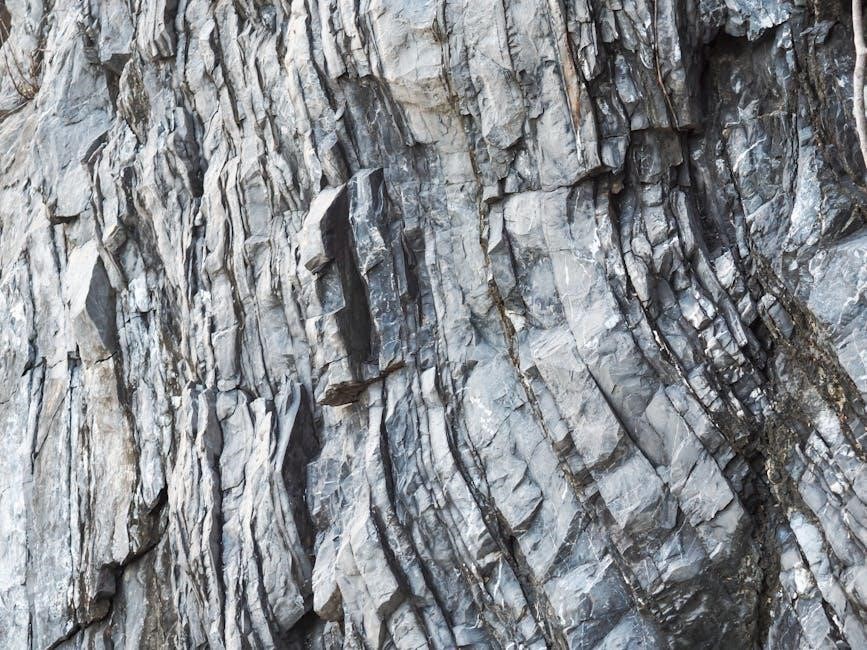
Geology, the study of Earth, encompasses rocks, minerals, and their origins; resources like field guides and online databases aid identification.
Understanding rocks and minerals is crucial, as they form our planet and are integral to various industries, from engineering to jewelry.
Numerous resources, including PDF lecture notes and research handbooks, provide comprehensive insights into the fascinating world of geology.
What is Geology?
Geology is the scientific study of the Earth, its structure, the materials of which it is made, and the processes that act upon it. It’s a broad discipline encompassing the history of our planet, from its formation billions of years ago to the present day. Geologists investigate everything from the microscopic composition of minerals to the large-scale movements of tectonic plates.
Central to geology are the studies of rocks and minerals, as these are the fundamental building blocks of our planet. Understanding their formation, classification, and properties is key to deciphering Earth’s history and predicting future changes. Resources like PDF lecture notes, readily available online, offer detailed explorations of these topics.
Furthermore, geology isn’t just about the past; it has significant implications for the present and future. It informs our understanding of natural hazards, resource management, and environmental issues. Field guides and comprehensive books, such as those detailing rocks, gems, and minerals, are invaluable tools for both amateur enthusiasts and professional geologists alike.
The Importance of Studying Rocks and Minerals
Studying rocks and minerals is paramount for understanding Earth’s history, processes, and resources. These materials provide a tangible record of our planet’s evolution, revealing clues about past environments, climates, and life forms. Detailed analyses, often found in geological PDFs, unlock these secrets.
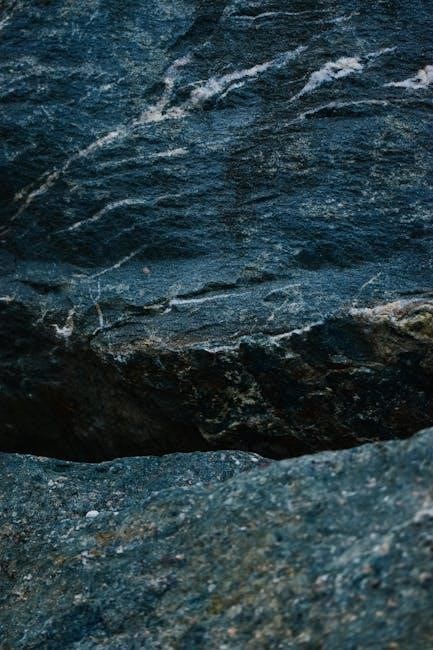
Beyond historical context, this knowledge is crucial for practical applications; Identifying minerals is essential in locating valuable resources like metals, fuels, and gemstones, driving economic growth. Understanding rock formations aids in civil engineering, ensuring stable foundations for structures.
Moreover, studying these materials helps us mitigate natural hazards. Recognizing rock types and mineral compositions can predict landslide risks and volcanic eruptions. Resources like field guides and research handbooks empower informed decision-making. A basic understanding, even from introductory articles, allows for appreciation of the world around us.
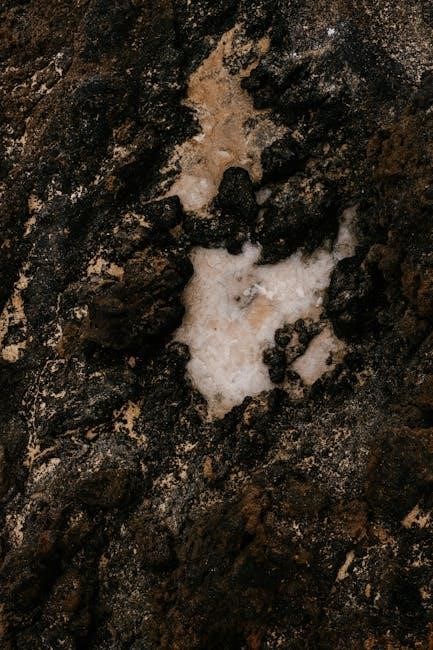
Minerals: The Building Blocks of Rocks
Minerals, naturally occurring solids with defined compositions, are fundamental components of rocks; PDFs detail their formation and properties for study.
What Defines a Mineral?
Minerals are naturally occurring, inorganic solids possessing a definite chemical composition and an ordered atomic arrangement. This crystalline structure is paramount; it distinguishes minerals from amorphous substances like glass. Resources, including downloadable PDF guides, emphasize these five key characteristics for proper mineral identification.
A mineral must be formed through natural geological processes – not synthetic creation in a laboratory. It cannot be organic, meaning it doesn’t originate directly from living organisms, though some can be formed by them indirectly. The chemical formula of a mineral is consistent, though some variation due to minor element substitution is permissible.
Furthermore, a mineral’s physical properties, detailed in geology PDFs, are directly linked to its internal atomic structure. Understanding these defining traits is essential for geologists and anyone interested in unraveling the Earth’s composition. These characteristics are consistently highlighted in educational materials.
Physical Properties of Minerals
Mineral identification relies heavily on observable physical properties, comprehensively detailed in geology and mineralogy PDFs. These characteristics stem from the mineral’s chemical composition and internal atomic structure. Key properties include color, streak, luster, and hardness, each providing clues to a mineral’s identity.
While color is immediately noticeable, it can be unreliable due to impurities. The streak – the color of a mineral’s powder – is more consistent. Luster describes how light reflects off the surface (metallic, glassy, etc.). The Mohs Hardness Scale, a standard reference in geological resources, ranks mineral resistance to scratching, from 1 (talc) to 10 (diamond).
PDF field guides often include tables and charts illustrating these properties, aiding in accurate identification. Mastering these properties is fundamental for both amateur enthusiasts and professional geologists studying Earth’s materials.
Color and Streak
Color, though the most obvious property, can be misleading when identifying minerals, as impurities frequently cause variations. Many minerals exhibit a range of colors, making it an unreliable diagnostic tool alone. Detailed geology PDFs emphasize the importance of considering other properties alongside color.
The streak, however, provides a more consistent indicator. Determined by rubbing a mineral across a streak plate (unglazed porcelain), the streak reveals the color of the mineral’s powder. This powdered form minimizes the influence of surface impurities, offering a more reliable characteristic.
Geological field guides and online resources often showcase streak colors alongside mineral descriptions. Comparing a mineral’s color and streak is crucial for accurate identification, as highlighted in numerous educational PDFs on rocks and minerals.
Luster
Luster describes how light interacts with a mineral’s surface, offering a key identification characteristic. It’s categorized broadly into metallic and non-metallic types. Metallic luster resembles polished metal – think pyrite or galena – reflecting light strongly. Detailed geology PDFs often include images illustrating these differences.
Non-metallic luster encompasses several subtypes: vitreous (glassy, like quartz), pearly (iridescent, like talc), resinous (like amber), silky (fibrous, like asbestos), and dull/earthy (non-reflective, like clay).
Accurately assessing luster requires observing how light reflects from a freshly broken surface. Comprehensive rock and mineral identification guides, available as PDFs, emphasize practicing luster determination. Understanding luster, alongside other properties, is vital for precise mineral classification, as detailed in engineering geology resources.
Hardness (Mohs Scale)
Hardness, in mineralogy, refers to a mineral’s resistance to scratching. The Mohs Hardness Scale, a relative scale from 1 to 10, quantifies this property. Talc, the softest, registers 1, while diamond, the hardest, is 10. Geology PDFs frequently illustrate this scale.
A mineral can scratch any substance with a lower Mohs number. Common reference materials include a fingernail (around 2.5), a copper penny (3.5), and a steel nail (5.5). Determining hardness involves attempting to scratch a mineral with these tools.
Field guides and online databases, often available as downloadable PDFs, provide detailed explanations and examples. Understanding the Mohs scale is crucial for preliminary mineral identification, particularly in engineering contexts where material durability is paramount, as detailed in rock and mineral identification resources.
Common Mineral Groups
Minerals are categorized into groups based on their chemical composition. Silicates, containing silicon and oxygen, are the most abundant, forming over 90% of Earth’s crust; geology PDFs extensively cover silicate structures.
Carbonates, like calcite and dolomite, are crucial in sedimentary rocks and often form from marine organisms. Oxides, combining metals with oxygen, include hematite (iron oxide) and magnetite, important ores. These groups are frequently detailed in introductory geology materials.
Understanding these classifications aids in identifying minerals and predicting their properties. Comprehensive field guides and online resources, often available as PDFs, provide detailed descriptions and identification keys for each mineral group, assisting both amateur enthusiasts and professionals.
Silicates
Silicates represent the most prevalent mineral group, constituting approximately 90% of Earth’s crust. Their fundamental structure involves silicon and oxygen atoms arranged in tetrahedra, forming diverse compositions. Geology PDFs dedicate significant sections to silicate classification, detailing frameworks, chains, sheets, and isolated tetrahedra.
Common silicate minerals include quartz, feldspar, mica, and olivine, each exhibiting unique properties and occurrences. These minerals are essential components of igneous, sedimentary, and metamorphic rocks. Understanding silicate structures is crucial for interpreting rock formation and geological processes.
Detailed diagrams and chemical formulas within geology resources, often available as downloadable PDFs, illustrate the complex arrangements within silicate minerals, aiding in accurate identification and analysis.
Carbonates
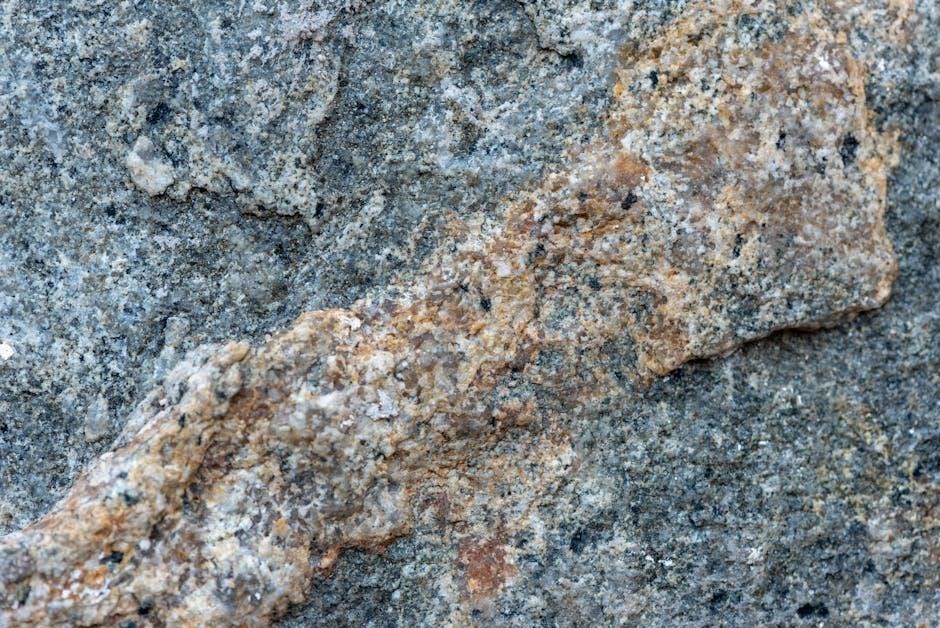
Carbonates are defined by the presence of the carbonate ion (CO32-), frequently combined with calcium, magnesium, or iron. Geology PDFs highlight their significance in sedimentary environments, particularly in the formation of limestone and dolostone. These rocks often originate from marine organisms’ shells and skeletons.
Calcite (CaCO3) is the most common carbonate mineral, exhibiting a characteristic reaction with dilute hydrochloric acid – a key identification test detailed in many field guides. Dolomite [CaMg(CO3)2] is another important carbonate, often found alongside calcite.
Geological resources, including downloadable PDFs, emphasize the role of carbonate rocks in carbon cycling and their vulnerability to dissolution, forming karst landscapes. Studying carbonates provides insights into past climates and environmental conditions.
Oxides
Oxides are minerals combining oxygen with one or more metals. Geology PDFs frequently showcase their economic importance, as many are primary ore minerals. Hematite (Fe2O3), a major iron ore, is a prime example, often displaying a reddish hue. Magnetite (Fe3O4) is another significant iron oxide, notable for its strong magnetic properties.
Corundum (Al2O3) is a notable oxide, forming the gemstones ruby (red) and sapphire (various colors). These are detailed in gem and mineral identification guides available as PDFs.
Geological resources emphasize that oxide formation often occurs through weathering processes or in magmatic environments. Understanding oxide mineralogy is crucial for resource exploration and understanding Earth’s geochemical history, as detailed in comprehensive geology texts.
Rocks: Aggregates of Minerals
Rocks, formed from mineral combinations, are categorized into igneous, sedimentary, and metamorphic types; PDFs detail the cyclical rock processes.
The Rock Cycle
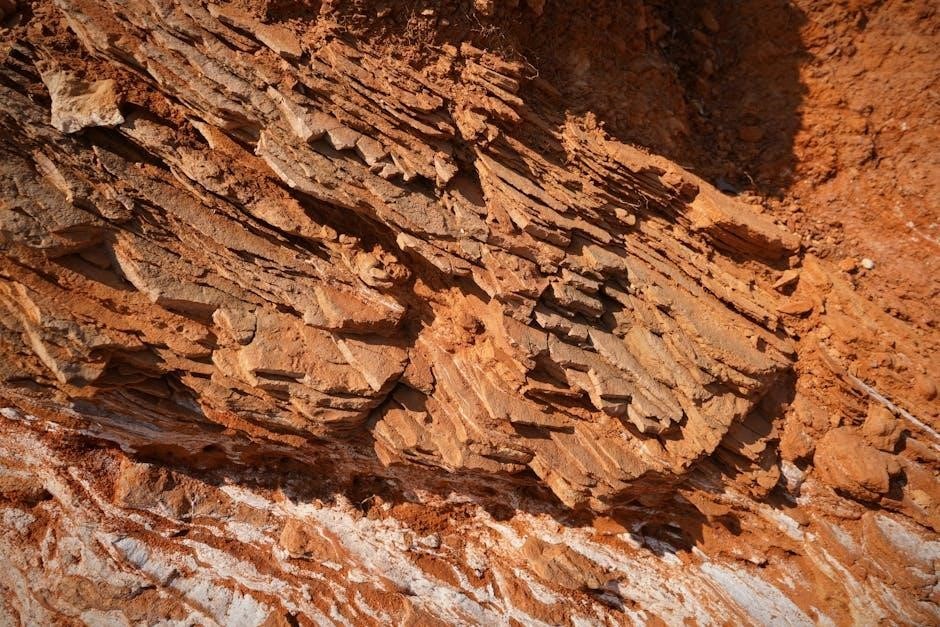
The rock cycle is a fundamental concept in geology, illustrating the continuous processes that create and transform rocks over immense timescales. This cyclical journey begins with igneous rocks, formed from the cooling and solidification of magma or lava. Through weathering and erosion, these rocks break down into sediments.
These sediments then undergo compaction and cementation, forming sedimentary rocks. Further heat and pressure, often deep within the Earth, can transform sedimentary (or even igneous) rocks into metamorphic rocks. Finally, metamorphic rocks can melt back into magma, restarting the cycle.
PDF resources and geological studies emphasize that this isn’t a linear progression; rocks can move directly between stages or repeat phases. Understanding the rock cycle, as detailed in various geology PDFs, is crucial for comprehending Earth’s dynamic nature and the interconnectedness of geological processes. It’s a constant state of creation, destruction, and reformation.
Types of Rocks
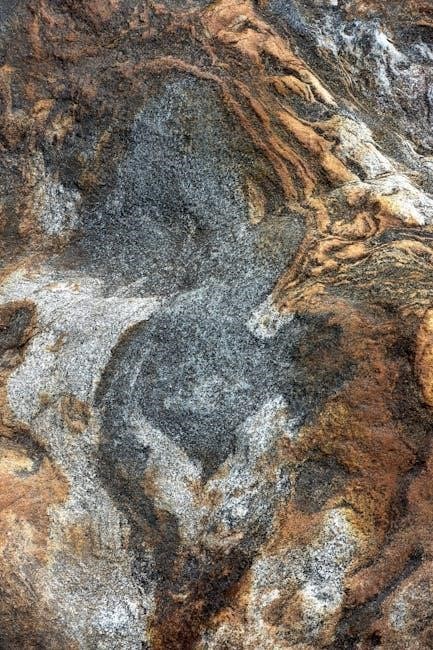
Geological classifications categorize rocks into three primary types: igneous, sedimentary, and metamorphic. These distinctions are based on their formation processes, as detailed in numerous geology PDFs and field guides. Igneous rocks originate from cooled magma, either below (intrusive) or above (extrusive) the Earth’s surface.
Sedimentary rocks form through the accumulation and cementation of sediments – fragments of other rocks, minerals, or organic matter. These often display layered structures. Metamorphic rocks arise when existing rocks are transformed by heat, pressure, or chemically active fluids, altering their mineral composition and texture.
PDF resources highlight that identifying a rock’s type is fundamental to understanding its history and the geological environment in which it formed. Each type provides valuable clues about Earth’s past and ongoing processes.
Igneous Rocks
Igneous rocks, born from the cooling and solidification of magma or lava, represent a fundamental rock type detailed extensively in geology PDFs. Intrusive igneous rocks, like granite, cool slowly beneath the Earth’s surface, fostering large crystal growth and a coarse-grained texture. Conversely, extrusive igneous rocks, such as basalt, cool rapidly on the surface, resulting in fine-grained textures or even a glassy appearance.
The mineral composition of igneous rocks dictates their color and density. Resources emphasize that studying these rocks provides insights into volcanic activity and the Earth’s internal processes. Identifying igneous rocks often involves examining their texture and mineral content, skills honed through field guides and online databases.
Formation of Igneous Rocks
Igneous rock formation begins with the melting of rock, typically within the Earth’s mantle or crust, a process detailed in numerous geology PDFs. This melting occurs due to increased temperature, decreased pressure, or changes in fluid content. The resulting magma, less dense than surrounding rock, rises towards the surface.
Cooling and crystallization are key. Slow cooling deep underground yields large crystals (intrusive rocks), while rapid cooling at the surface produces small or no crystals (extrusive rocks). Mineral composition is dictated by the magma’s chemistry. Understanding these processes, as outlined in research handbooks, is crucial for interpreting Earth’s history and volcanic activity.
Examples of Igneous Rocks
Granite, a coarse-grained intrusive rock, is commonly found in continental crust, its formation detailed in many geology PDFs. Basalt, a fine-grained extrusive rock, dominates oceanic crust and volcanic landscapes. Obsidian, volcanic glass, cools so rapidly it lacks crystal structure, a characteristic explored in field guides.
Diorite, an intermediate composition intrusive rock, showcases a speckled appearance. Pumice, a lightweight extrusive rock, forms from gas-rich lava. Studying these examples, as presented in comprehensive resources, allows for understanding the diverse range of igneous rock compositions and textures, revealing insights into Earth’s dynamic processes and geological history.
Sedimentary Rocks
Sandstone, formed from cemented sand grains, often displays visible layering, a key feature detailed in geology PDFs. Shale, a fine-grained rock from compacted mud, frequently contains fossils, providing insights into past life. Limestone, primarily composed of calcium carbonate, often originates from marine organisms, as explained in various field guides.
Conglomerate, containing rounded gravel, indicates high-energy depositional environments. Breccia, with angular fragments, suggests shorter transport distances. Examining these sedimentary rocks, as presented in comprehensive resources, reveals clues about past environments, erosion, and depositional processes, offering a window into Earth’s history and geological evolution.
Formation of Sedimentary Rocks
Sedimentary rock formation begins with weathering and erosion, breaking down existing rocks into sediments – sand, silt, clay, and gravel. These sediments are then transported by wind, water, or ice, accumulating in layers through deposition. Compaction, the weight of overlying sediments, reduces pore space, while cementation binds the particles together with minerals like calcite or silica, solidifying the sediment into rock.
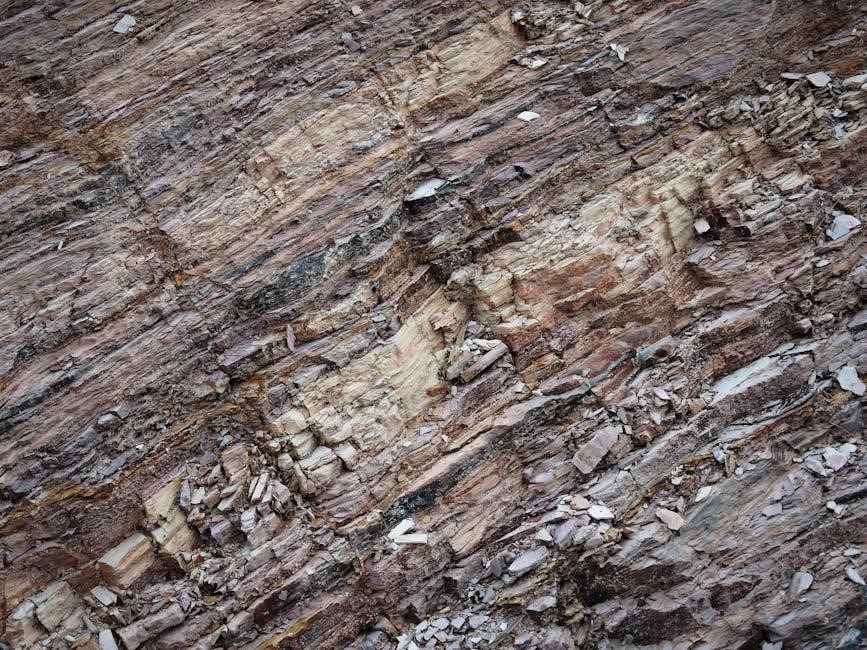
Geology PDFs detail these processes, highlighting how different environments – rivers, lakes, oceans – create distinct sedimentary structures like bedding and cross-bedding. Understanding these steps, as outlined in research handbooks, is crucial for interpreting Earth’s history recorded within sedimentary layers, revealing past climates and geological events.
Examples of Sedimentary Rocks
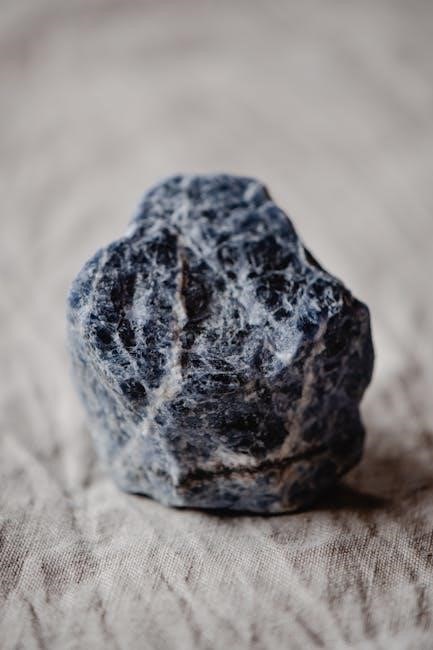
Sandstone, formed from cemented sand grains, is a common example, often displaying visible layering. Shale, created from compacted clay, is fine-grained and easily split into layers. Limestone, primarily composed of calcium carbonate from marine organisms, frequently contains fossils, offering insights into past life.
Geology resources, including field guides and PDFs, showcase these rocks and their variations. Conglomerate, with rounded gravel embedded in a finer matrix, indicates high-energy depositional environments. Breccia, similar to conglomerate but with angular fragments, suggests shorter transport distances. Studying these examples, detailed in available literature, helps understand Earth’s dynamic history and the processes shaping our landscapes.
Metamorphic Rocks
Metamorphic rocks arise from existing rocks transformed by heat, pressure, or chemically active fluids. Slate, formed from shale, exhibits excellent cleavage, making it ideal for roofing. Marble, originating from limestone, displays a crystalline texture and is prized for sculpture.
Resources like geology PDFs detail how gneiss, with its banded appearance, results from high-grade metamorphism. Quartzite, derived from sandstone, is incredibly hard and durable. Understanding metamorphic processes, as outlined in field guides, reveals Earth’s internal forces; These transformations offer clues about tectonic activity and the planet’s evolving structure, showcasing the dynamic interplay between rocks and their environment.
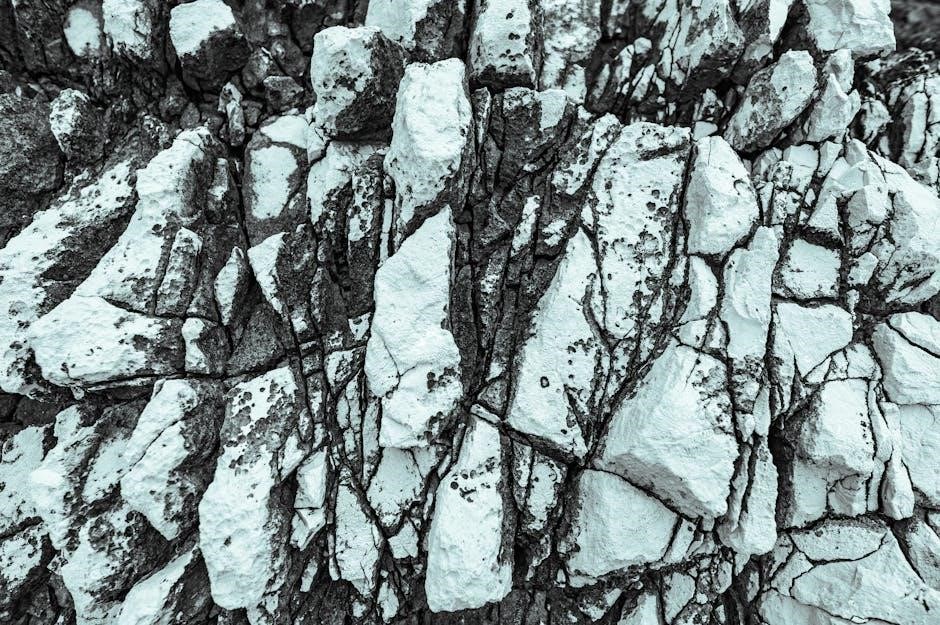
Formation of Metamorphic Rocks
Metamorphism, detailed in geology PDFs, occurs when pre-existing rocks undergo physical or chemical changes without melting. Heat, from magma or Earth’s core, drives recrystallization. Pressure, caused by burial or tectonic forces, alters mineral alignment. Chemically active fluids introduce or remove elements, changing composition.
Regional metamorphism affects large areas during mountain building, while contact metamorphism occurs locally near igneous intrusions. These processes, explained in research handbooks, result in new minerals and textures; Foliation, the alignment of minerals, is common in metamorphic rocks. Understanding these formations, as illustrated in field guides, reveals Earth’s dynamic history and internal processes.
Examples of Metamorphic Rocks
Slate, formed from shale, exhibits excellent foliation, making it ideal for roofing, as detailed in geology resources. Marble, metamorphosed limestone, is prized for its beauty and used in sculptures and buildings. Quartzite, derived from sandstone, is incredibly hard and durable, often found in mountainous regions.
Gneiss displays distinct banding due to mineral segregation during high-grade metamorphism, explained in PDF lecture notes. Schist contains visible, platy minerals like mica, giving it a sparkly appearance. These rocks, showcased in field guides, demonstrate the transformative power of heat and pressure. Studying these examples, found in comprehensive PDFs, provides insight into Earth’s geological processes.

Identifying Rocks and Minerals
Field identification relies on observing physical properties; resources like guides and online databases, often in PDF format, are invaluable tools.
Field Identification Techniques
Successful rock and mineral identification in the field begins with careful observation, utilizing readily available tools and techniques. A hand lens is essential for examining crystal structures and textures, revealing crucial clues about a specimen’s origin and composition.
Color, while a preliminary indicator, can be misleading due to weathering or impurities; therefore, assessing streak – the color of a mineral’s powder – provides a more reliable characteristic. Luster, describing how light reflects off a surface (metallic, glassy, dull), is another key observation.
Hardness, measured using the Mohs scale (scratching resistance), helps differentiate minerals. Portable field guides, often available as PDF downloads, offer comparative charts and detailed descriptions. Observing cleavage or fracture patterns – how a mineral breaks – further aids identification. Remember to document location data, as geological context is vital for accurate assessment.
Resources for Identification (Field Guides, Online Databases)
Numerous resources exist to aid in rock and mineral identification, ranging from traditional field guides to comprehensive online databases. Books like Charles Sorrell’s “Rocks and Minerals” provide detailed descriptions and visual aids, often including identification keys.
Golden Guides, known for their accessibility, offer authoritative yet easy-to-use information. Digitally, many universities and geological surveys provide free PDF lecture notes and downloadable charts. Online databases, such as Mindat.org, offer extensive mineral information, photos, and locality data.
Geological surveys often publish regional guides specific to local rock formations. Utilizing a combination of these resources – physical guides alongside digital databases – maximizes identification accuracy and expands geological knowledge. Remember to cross-reference information for confirmation.